House washing in Southfield.
Siding, brick and trim.
Washing the outside of the house — vinyl siding, brick, soffit and trim. Not housecleaning, and not a blast: both of the industries that make these walls publish limits on how hard you may hit them.
A referral service for Southfield homeowners. An automated assistant answers; calls are recorded.
Typical cost: $170 – $360, most about $265 — a national range, about $1 a foot of wall on one story and $2 on two (HomeGuide's national chart, June 2025)
- Cost to call
- Nothing
- Answered by
- Automated assistant
- Hours
- Any hour
Vinyl siding
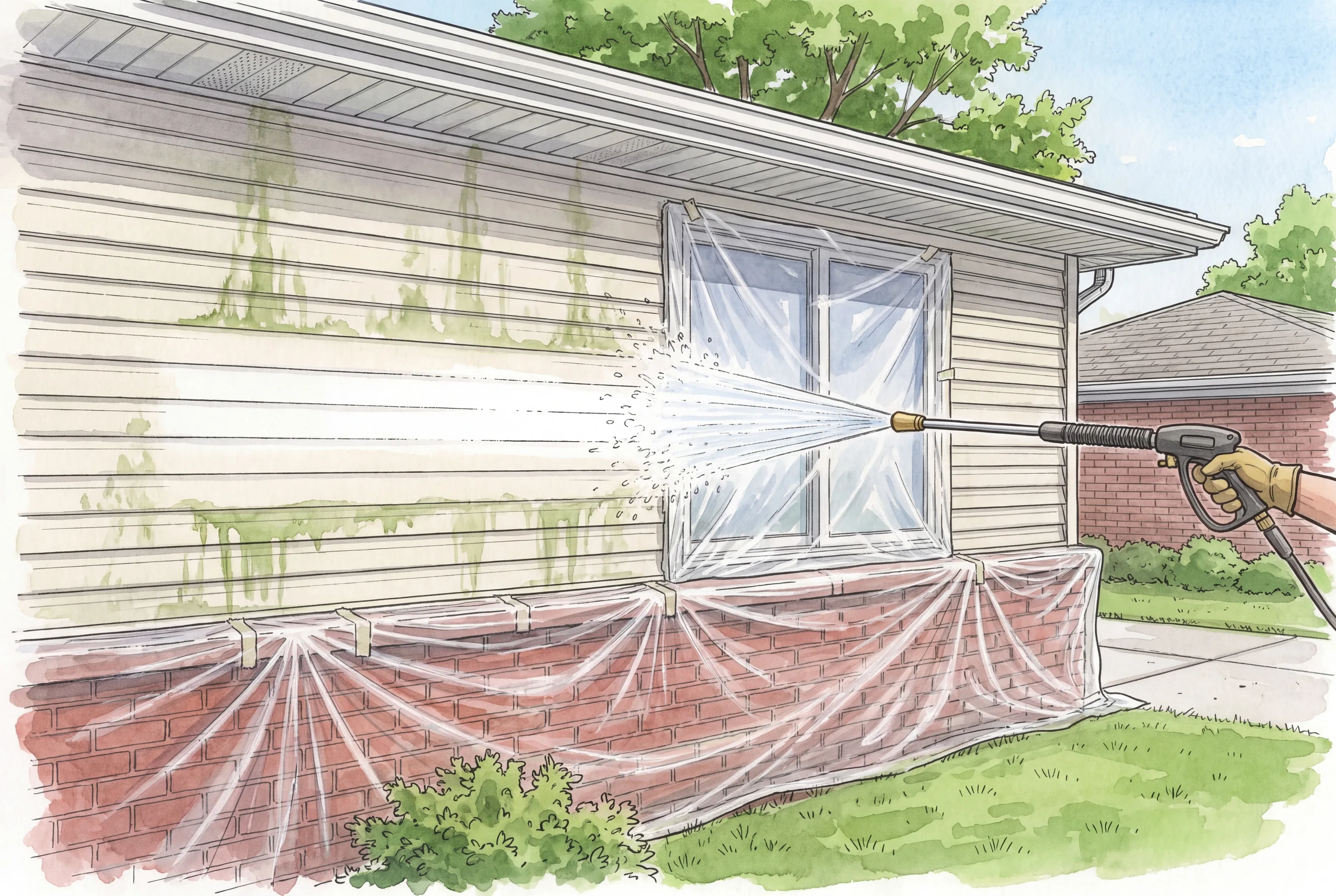
The siding industry's own cleaning page allows a power washer — “yes, a power washer can be used, but with caution” — and then sets out how. These are its instructions, in its order (how to clean vinyl siding).
- Read the siding's own instructions first. Some siding makers do not recommend power washing at all, and others set limits on the pressure and on what cleaners may be used.
- Hold the wand level, at eye height. Never aim the stream upward: that forces water behind the panels.
- Work bottom to top, and rinse the cleaning solution off completely before it can dry on the surface.
- Stay off windows, doors, wiring and plumbing. Many manufacturers caution against pressure washing around them.
- Cover brick and stone accents so the runoff does not land on them.
The same page's avoid-list: cleaners containing organic solvents, undiluted chlorine bleach, liquid grease remover, nail polish remover and furniture polish (how to clean vinyl siding).
Brick and masonry
Brick has a published ceiling, and it is far below what a machine can do (the brick industry's cleaning guidance).
- 400 psi at the nozzle tip is the limit unless the brick maker permits more.
- Above 800 psi, the guidance calls high pressure water cleaning inappropriate for brick and says it may damage the brickwork.
- A 25 to 50 degree fan tip, held at least twelve inches off the wall. A narrow tip held close is how mortar joints get eroded and finishes get stripped.
- Runoff is the cleaner's problem to control, to whatever the local rule says — which in Southfield is the rule about storm drains.
The white bloom
The chalky white on brick is not dirt. It is salt that water carried to the surface and left there when the water evaporated, and three things have to coexist for it: soluble salts in the wall, water in contact with them long enough to dissolve them, and a pore structure that lets the solution travel (what efflorescence is).
It is usually not harmful to the brickwork. Bloom on new brick weathers off on its own inside a year; light bloom brushes off dry or with a stiff fiber brush and water (the same guidance · removing it).
If it keeps coming back, washing it off again will not fix it. The guidance is to find and correct the water getting into the wall first, and let the brickwork dry, before cleaning the bloom at all (what efflorescence is).
When
Cleaning with water alone wants the temperature at 40 °F or above and staying there until the wall is dry, and ideally above freezing for seven days after. Chemical cleaning wants 50 °F or above. The guidance says plainly not to clean in freezing weather or when freezing weather is expected, because that risks harming the masonry and bringing out more bloom (the brick industry's guidance).
For a rough outside edge: the two nearest weather stations with long records give 50/50 freeze dates of April 28 and October 17 at the Oakland County airport, and April 18 and October 30 at Detroit City Airport. Those are airport readings, not Southfield ones, which is why this is a bracket and not a date (the freeze normals).
Covering the brick is part of washing the siding.
The siding industry's own instruction is to cover brick and stone accents before washing, so the runoff from the siding does not land on them. how to clean vinyl siding
Ask whether the brick is being covered or washed. They are two different jobs at two different pressures.
Questions
Is this the same as house cleaning?
- No — this is the outside of the house: siding, brick, soffit, trim and gutters seen from the outside. Nobody goes inside.
Will it strip my paint?
- It can, at the wrong pressure: the brick guidance warns that excessive pressure erodes mortar joints and removes finishes and surface coatings. That is the reason for the 400 psi ceiling and the wide tip held a foot back (the brick industry's guidance).
What about the gutters?
- The outside face of a gutter is usually washed with the house and is priced with it. A national chart puts gutter exteriors on their own at $55 – $160 (HomeGuide, June 2025).
Will I be charged for the visit?
- Calling us costs nothing. Some contractors charge to come out and look at the job. Ask before they come, and get the price in writing.